Brazil’s Fixed-Odds Betting Ban: What Changed, and Why Payments Are Central to the Transition
On 25 September 2026, Brazil prohibited fixed-odds betting under Provisional Measure 1,394/2026, with payment institutions explicitly included in the restrictions.
On 25 September 2026, Brazil issued Provisional Measure 1,394/2026, prohibiting the operation, offering, intermediation and advertising of fixed-odds betting throughout the country. The text covers bets on real sporting events and virtual online-game events.
The measure is broader than an online-casino-only ban: it targets the fixed-odds betting category itself.
The transition began immediately
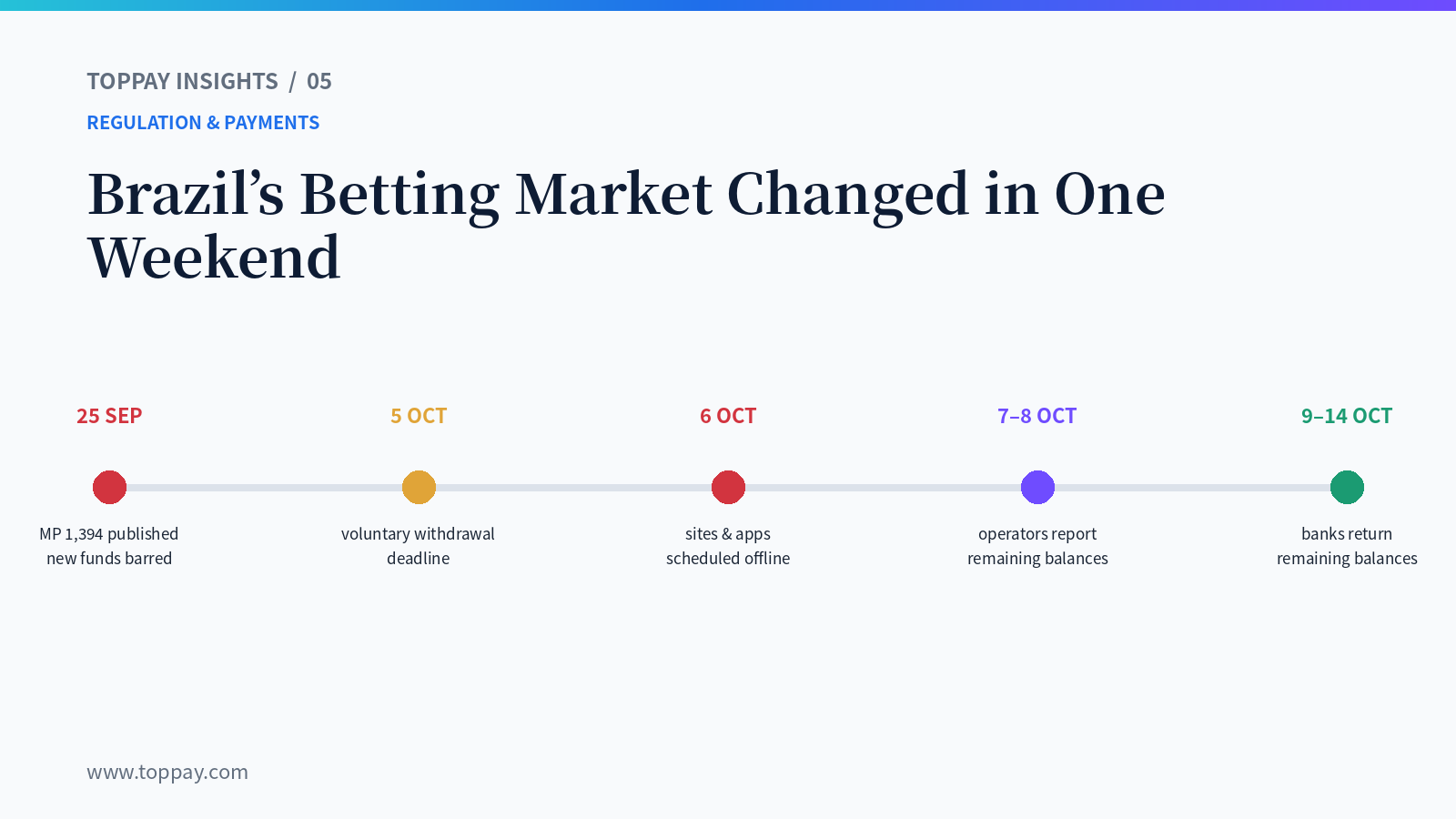
The measure took effect on publication. From that date, new funds could no longer be added to betting transaction accounts, subject to limited wind-down exceptions. The federal government also published a transition schedule: voluntary withdrawals through 5 October; sites and apps scheduled to go offline from 6 October; operator reporting of remaining balances on 7-8 October; and bank returns of remaining balances from 9-14 October.
The legal text also provides for the extinction of federal, state and district fixed-odds betting authorizations after the transition period set out in the measure.
This is a Provisional Measure, not the end of the legislative process
Brazilian provisional measures have immediate force of law but remain subject to congressional consideration. As of 28 September 2026, the National Congress page showed MPV 1,394/2026 as published on 25 September and still under consideration, with no amendments or later legislative text displayed.
For public-facing content, the careful description is therefore that the prohibition is currently in force under Provisional Measure 1,394/2026 and remains subject to Brazil’s constitutional legislative process.
Payments are explicitly covered
Article 14 is especially relevant to PSPs. Except for transactions required to wind down operations and return funds to bettors, financial institutions, payment institutions, payment-arrangement operators and other arrangement participants - including instant-payment participants - are prohibited from processing, settling or enabling transactions destined for fixed-odds betting, subject to Central Bank regulation.
That makes the development a payment-infrastructure event as much as a gaming-regulation event.
Enforcement followed quickly
On 27 September, a task force involving the Ministry of Justice and Ministry of Finance said it had taken down 506 domains showing indications of irregular betting activity after the new measure. The figure is an enforcement-action count, not a measure of the size of the Brazilian gambling market.
The bigger payment lesson: rail availability is not merchant permission
Pix remains a major Brazilian payment rail. Banco Central do Brasil reported 42.9 billion Pix transactions in the second half of 2025, representing 54.7% of payment transaction count. The technical usefulness of Pix does not disappear because a particular commercial activity becomes prohibited.
What changes is transaction permissibility. A rail can remain fast, widely used and fully operational while one merchant use case becomes legally unavailable.
Market access has at least four layers
For regulated or higher-risk verticals, market access should be separated into four controls: rail availability, merchant eligibility, transaction permissibility and ongoing regulatory status. The first is largely technical. The other three can change independently of the integration.
Onboarding cannot be the final compliance checkpoint
A merchant can pass KYB, provide a valid licence and begin processing, while the regulatory environment later changes. Payment infrastructure therefore needs the ability to reassess permissions, stop new deposits, preserve legitimate wind-down flows, return balances and update routing without waiting for a complete rebuild.
Market access is not something a payment company checks once. It is a condition that can change while transactions are already flowing.