Vietnam iGaming: Demand, Digital Payments and Enforcement Are Moving at Different Speeds
The market matters because strong consumer-interest, payment and regulatory signals are moving in different directions.
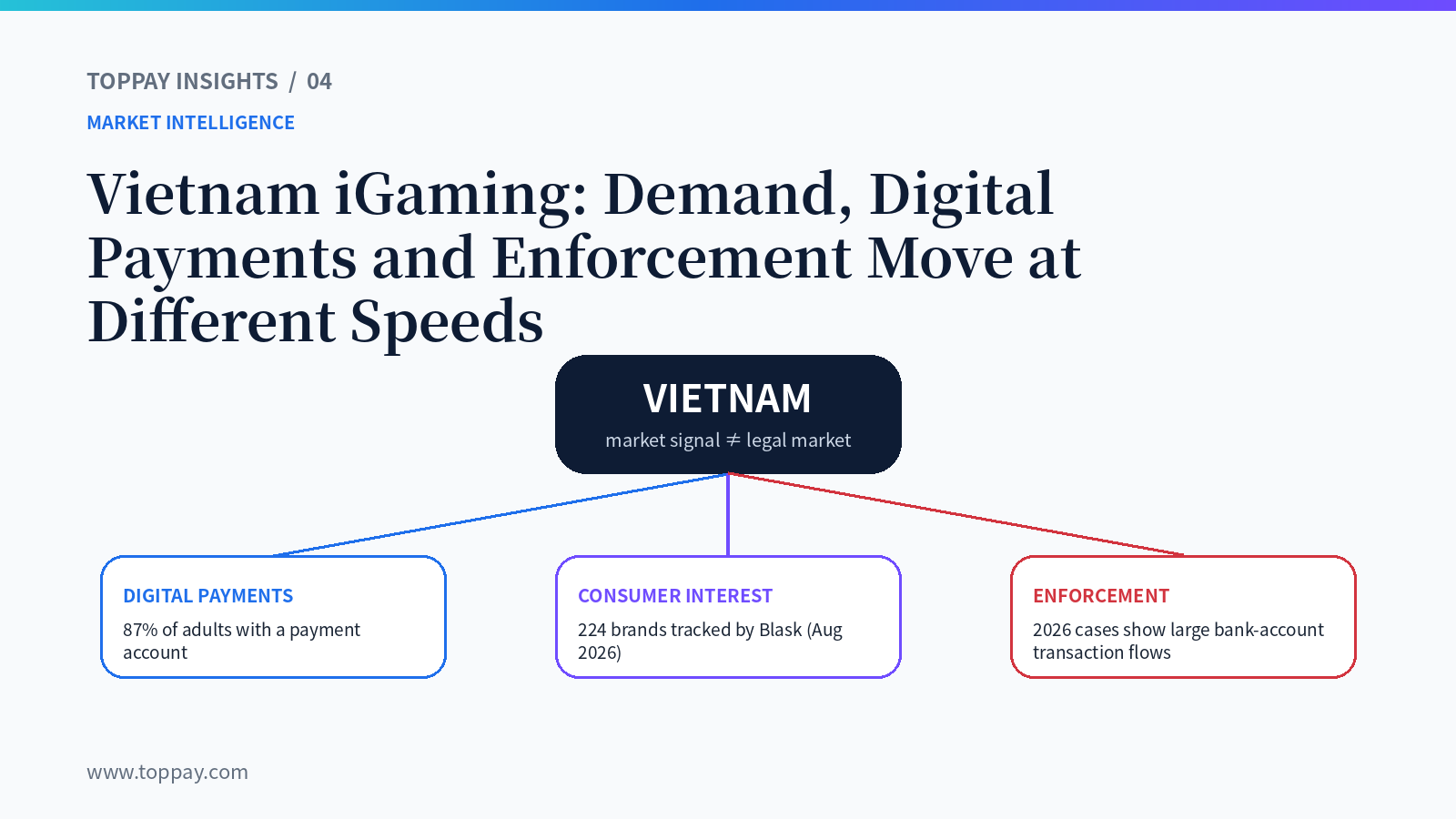
Vietnam is worth studying precisely because the easiest numbers to find are also the easiest to misread. Online gambling interest is visible. Digital payments are deeply embedded in everyday life. At the same time, the government keeps tight control over gambling activity and police continue to act against unauthorized online operations.
Demand, payment behaviour and legal market access should be analysed as three separate layers.
Limited casino access should not be confused with broad online authorization
In November 2025, the Government issued Resolution No. 8/2025/NQ-CP allowing qualified Vietnamese nationals to enter the Phu Quoc, Ho Tram and Van Don casino projects under defined conditions. Ho Tram and Van Don operate under five-year pilot arrangements. The policy concerns designated casino projects; it should not be interpreted as broad authorization of online gambling.
Enforcement remains active in 2026
In August 2026, Ho Chi Minh City police reported dismantling an online gambling network with nearly VND560 billion in preliminary bank-account transaction value. On 26 September, Hung Yen police announced an investigation involving more than VND1 trillion in transactions through 13 bank accounts linked to an alleged online gambling operation.
Those figures describe transaction flows identified in enforcement cases. They are not Vietnam gaming revenue, player losses or operator GGR. That distinction is essential in public-facing market analysis.
Consumer-interest data points to a fragmented online market
Blask’s Vietnam market page for August 2026 listed 224 brands and reported consumer-interest measures such as BAP and the Blask Index. These indicators can help describe visibility and fragmentation, but they are modeled market-intelligence signals rather than regulator-reported financial market share.
For TopPay, the safe editorial approach is simple: label modeled data as modeled data. It can provide a useful view of demand without being presented as certified revenue.
Vietnam is already highly digital in payments
At Vietnam’s 2025 Banking Digital Transformation Day, the government reported that 87% of adults had a payment account, above the 2025 target of 80%. It also reported that cashless-payment value in 2024 exceeded VND295 quadrillion, equivalent to roughly 25 times GDP.
That tells us something important about consumer behaviour: digital bank accounts, transfers, QR and mobile-payment experiences are already normal. It does not mean every merchant category is permitted to use every payment channel.
Payment familiarity and merchant eligibility are separate questions
A payment method can be widely used while a particular merchant activity remains restricted. A customer can be completely comfortable with QR transfer while the underlying commercial transaction still fails eligibility or compliance requirements.
For PSPs, the market question therefore cannot stop at “Which payment methods do consumers use?” It must also ask: “Who is allowed to collect through them, for which activity, and under what current rules?”
How operators and payment providers should read Vietnam
The most accurate conclusion is not simply that Vietnam is a “high-growth iGaming opportunity”. A more useful description is that Vietnam combines meaningful observable online-gambling interest, a highly digital payment population, limited legal gambling channels and active enforcement.
Knowing how money moves solves only half the problem. Knowing when it is allowed to move solves the other half.
Sources
- 01Government of Viet Nam - Resolution No. 8/2025/NQ-CP summary
- 02Vietnam Ministry of Public Security - HCMC online gambling case, 20 Aug 2026
- 03Vietnam Ministry of Public Security - Hung Yen online gambling case, 26 Sep 2026
- 04Government of Viet Nam - Banking Digital Transformation Day 2025
- 05Blask - Vietnam market overview (modeled market-intelligence data)